The short answer
A data center company cannot condemn your land. Eminent domain, the power to take private property for a public use and pay for it, belongs to governments, and a state can hand it to a regulated utility that builds lines and substations for the public. So the realistic risk for a landowner is rarely that a developer takes the field where a campus will stand. The campus is bought by agreement. The risk is a transmission line, a substation or a pipeline that a utility needs in order to serve the campus, and that has to cross somebody’s property.
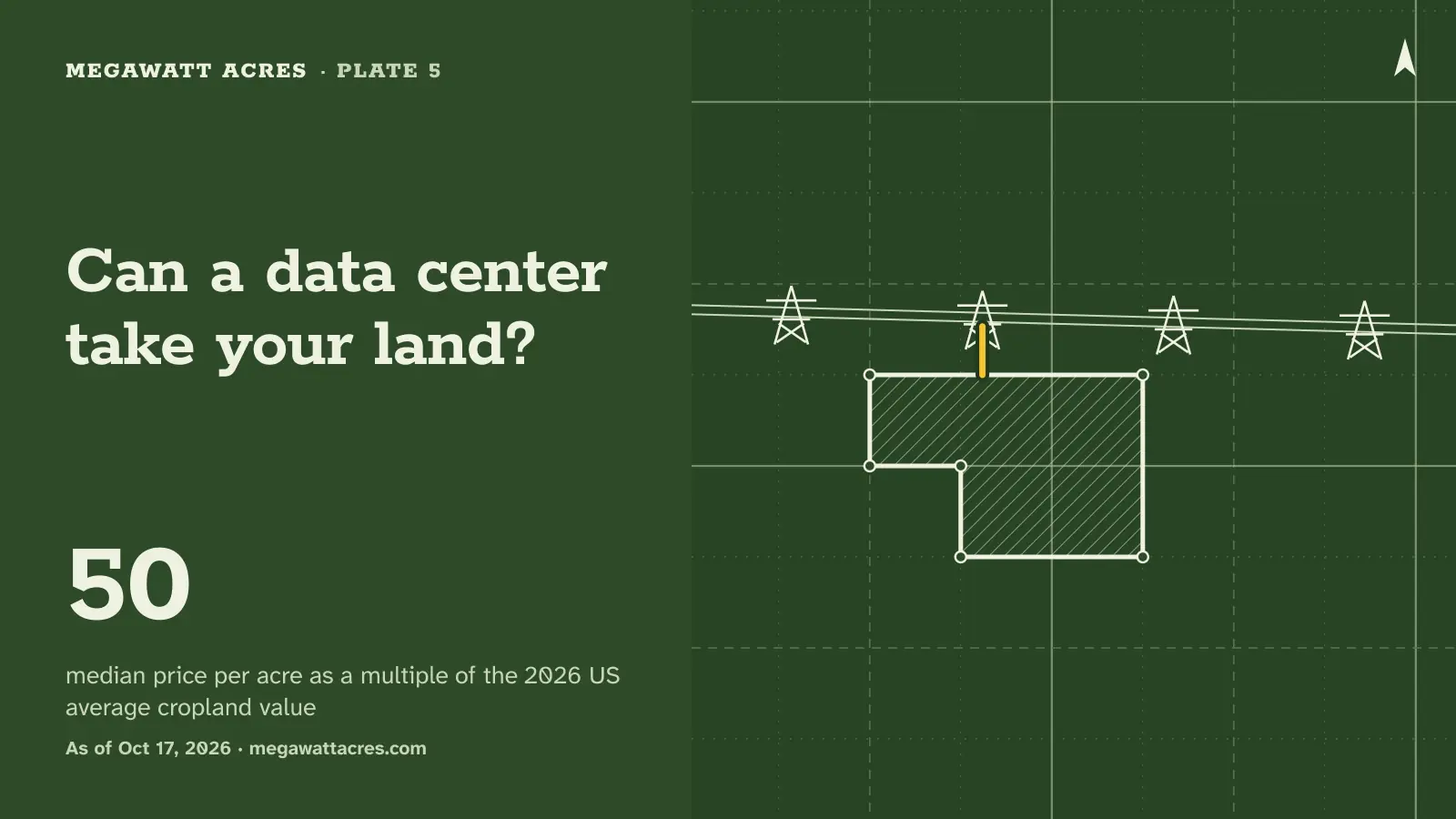
Whether that taking is lawful depends on two tests: public use and just compensation. Public use is read generously by the US Supreme Court, and more strictly by a number of state constitutions. Just compensation is generally fair market value, what a willing buyer would pay a willing seller, and it is not the same as the price a data center developer pays for powered land. In our table of 34 closed US land-only data center sales, the median price is $301,896 an acre, about 50 times the $6,020 that USDA reports as the 2026 average for US cropland. Those are voluntary prices for land with power, and a condemnation award is set by a different process.
This guide explains who can condemn and who cannot, what the courts have said about public use, how a line built for a data center gets approved, what the live 2026 disputes look like, what the law says you are owed, and what to do if a land agent calls. It is a plain-language guide, not legal advice. Every option, easement, lease or sale contract should be reviewed by your own attorney, and the tax side by your own CPA. The answer in your state may differ from the examples here, and a few of them are still being argued in court.
Who can condemn, and who cannot
Governments, and those they delegate to
The Fifth Amendment allows the taking of private property only for “public use” and only with “just compensation.” The federal government can start condemnation actions, but, as University of Dayton law professor Aaron Walayat writes, most are brought by state and local governments. Governments can also delegate the power to private entities, usually “common carriers” such as power and water utilities. Each state sets its own rules on whether and how a utility may use it.
The delegation is the part that matters here. A regulated electric utility that holds a state certificate for a transmission line can sue to condemn the easement for that line. In the words of the Compute Law blog, which tracks the issue for data center lawyers, only regulated utilities holding a state siting certificate can use eminent domain for a transmission line, and a private AI data center developer cannot.
What a data center developer can and cannot do
A developer can make you an offer, and it can option your land, buy it, lease it or ask for an easement. It cannot sue to take your land. Texas states this directly: a government or private entity may not take property by eminent domain if the taking confers a private benefit on a particular private party, is a pretext for conferring that benefit, or is for economic development. The same section leaves intact the power to take property for utility services and for common carrier pipelines, which is where the real fights happen.
So when you read that “a data center can seize your land,” the sentence is usually shorthand for one of three different things:
- A utility is asking to condemn an easement for a line that mainly serves a data center, and the question is whether that line is a public use.
- A city or county is condemning land for its own purposes, sometimes to stop a data center, as Nashville has tried to do.
- A developer is pressuring a holdout owner with talk of eminent domain that it does not hold. A buyer that says “we can take it anyway” may be repeating a utility’s position, or may be bluffing. Ask who the condemning authority would be.
That third point is worth a moment. Because a private developer has no power to condemn, a land agent who implies otherwise has told you something that needs checking. Ask the agent for the name of the utility or agency that would file the case, and for the state approval, if any, behind the project. If no certificate or approval exists yet, any talk of condemnation is at best early.
What “public use” means after Kelo
The 2005 decision
Most people first heard of eminent domain for private development through Kelo v. City of New London. In that 2005 case the Supreme Court, by a 5–4 vote with Justice Stevens writing for the majority, held that a city’s plan to take homes for economic development was a public use under the Fifth Amendment. The Court said that “promoting economic development is a traditional and long accepted function of government,” and it declined to adopt a bright-line rule against such takings.
Two parts of the opinion matter for landowners today. First, the Court said a city could not take property simply to give a private benefit to a particular private party, and that such a taking would be unconstitutional. A private benefit is allowed to follow from a public purpose, but it cannot be the purpose. Second, the Court said that nothing in its opinion precludes any state from placing further restrictions on its exercise of the takings power. That sentence is the reason your state’s law matters more than the federal rule.
The New London redevelopment never happened, and Pfizer, the company whose facility anchored the plan, eventually left the city, as Walayat notes.
What the states did next
The backlash was fast. According to Walayat, 45 states enacted eminent domain reform laws after Kelo, and the supreme courts of Michigan, Ohio and Oklahoma have barred seizing property purely for economic development to transfer it to another private party. The Ohio case, Norwood v. Horney, was decided in July 2006. The court held that it had never found economic benefits alone to be a sufficient public use for a valid taking, and it declined to do so, calling property rights original and fundamental.
Reform laws differ in strength. Many ban takings for general economic development, and many keep an exception for blighted areas. Utilities are almost always carved out, because a state wants its power lines built. That is why the protections added after Kelo help against a city that wants your land for a shopping district much more than against a utility that wants a 150-foot-wide strip for a transmission line.
Two states, two approaches
Virginia and Texas, two states where much of the data center building and the line-building is happening, show the range.
Virginia amended Article I, Section 11 of its constitution, effective January 1, 2013. The amendment says a taking or damaging of private property is not for public use if the primary use is for private gain, and it lists private benefit, private enterprise, job creation, tax revenue and economic development as takings that do not qualify. It puts the burden on the condemnor to prove the use is public, without a presumption that it is. Utilities, common carriers and railroads keep the power to condemn when exercising their authorized services. The amendment also sets a floor for payment: just compensation shall be no less than the value of the property taken, lost profits and lost access, and it covers damage to the land you keep.
Texas covers the same ground by statute. Government Code section 2206.001 bars takings that confer a private benefit on a particular private party, takings that use a public use as a pretext, and takings for economic development, except where the development is a secondary result of urban renewal aimed at eliminating blight. Subsection (c) then preserves the power to take property for utility services and for the operations of a common carrier pipeline. Texas courts add a requirement of their own for common carriers. In the Denbury Green carbon dioxide pipeline litigation, the Texas Supreme Court held in 2012 that a pipeline “must serve the public; it cannot be built only for the builder’s exclusive use,” and that merely checking a box on a state form does not make a company a common carrier. In 2017 the court said the test is whether the pipeline will probably serve the public after it is built, and that a reasonable probability of serving even one unaffiliated customer is enough.
The Denbury cases concern pipelines, not power lines, and a Texas court would not necessarily apply them the same way to a transmission line. They do show the style of reasoning: courts ask whether the facility serves the public in fact, and a label on a form is not enough.
Power lines and substations built for data centers
How a line gets approved
For the owner of a rural parcel, the process of approving a transmission line is where eminent domain becomes real. The details differ by state, but the Compute Law blog describes the common shape:
- The utility identifies a need and proposes a route.
- It files for a certificate of convenience and necessity, or its equivalent, with the state utility commission.
- Notice goes to affected owners, and public hearings are held.
- The commission approves or denies. Approval is what triggers the power to condemn.
- The utility negotiates easements, usually on a good-faith offer tied to an appraisal.
- If an owner refuses, the utility files a condemnation case. In many states three special commissioners set compensation first, and an owner can appeal for a trial.
The practical point is that the best moment to take part is early, when the commission is deciding on the route. By the time a land agent knocks on your door with an easement form, the certificate is often already issued, and the argument has narrowed to the price and the terms.
The open question: a line for one customer
Courts have long assumed that electric transmission serves the public. The new question is whether a line built mainly for one privately owned AI data center still does. Public-use challenges succeed more easily when the facility serves a single private customer than when it serves a grid.
The decided cases mostly favour utilities. Walayat reports that the supreme courts of South Dakota and Vermont upheld power company takings, finding that providing at least some energy to in-state customers and improving grid reliability were valid public uses. Going the other way, the Mississippi Supreme Court in 1984 rejected a condemnation for a line that ran from Mississippi into Louisiana and would not benefit any Mississippi customers. Walayat’s own view is that seizing land to improve grid reliability will likely count as public use, especially where it serves in-state customers, and that owners may still have grounds to challenge a line that does not actually serve them.
The Compute Law blog says plainly that no court has yet ruled that an AI data center line fails the public use test. So the honest status of the law is this: utilities are on solid ground when a line also serves the wider grid; a line built for exactly one private campus is a weaker case for the utility, but it has not yet been decided by a court in the states where the fights are going on. If you are in that situation, an eminent domain attorney in your state is the person to ask, because the answer depends on your state’s constitution and on the facts of the certificate.
The disputes running in 2026
Several lines linked to data centers were in dispute as of the summer of 2026. These are reports, not rulings, and the details come from the press and the utilities.
Georgia. Georgia Power’s Ashley Park to Wansley project is a 35-mile line through Fayette, Heard, Fulton and Coweta counties. Fortune reports that Georgia Power’s wider grid plan includes more than 1,000 miles of transmission lines across more than 330 parcels and would require leveling nearly 30 residential properties. Georgia Power says it starts offers at 125% of appraised value, calls that a starting point open to negotiation, lets owners sell outright or grant an easement or right of way, and says eminent domain is a last resort: used in under 1% of land transactions, five times in the past year, and never on residential homes. The utility says it is not in the data center business and denies that the line is data-center focused. CBS estimated that data centers would use 70 to 80 percent of the line’s power, a figure Georgia Power could not confirm. A Georgia eminent domain attorney quoted by Fortune said permanent easements run with the property after a sale, can bar permanent structures under the lines, and may allow utilities to add infrastructure, and that the agreements tilt toward the power company even though compensation is offered.
Virginia. Newsweek reports that Dominion Energy’s Golden to Mars project in Northern Virginia could run through an Ashburn homeowner’s yard, with a 185-foot pole planned after state regulators approved the route.
Pennsylvania. Farmers in Union and Lycoming counties oppose a PPL Electric Utilities line that would serve a data center complex at Great Stream Commons in Allenwood. One farmer told Newsweek the line serves a single customer, not the broader grid. PPL and the developer had not responded when the story ran.
Maryland. Farmers oppose the 67-mile Maryland Piedmont Reliability Project across Baltimore, Frederick and Carroll counties. PSEG has floated eminent domain if landowners refuse, and says the upgrades are needed to prevent congestion and protect affordability and reliability.
Indiana. AES Indiana proposes a roughly 10-mile, 345-kilovolt line in Morgan County, linked to Google’s planned data center near Monrovia. No final route had been selected. AES says the project serves the broader system and that large-load customers go through a separate approval process.
Notice what these cases have in common. In each one the dispute is about a line, and in each one the utility describes the line as serving the whole system while landowners describe it as serving one customer. That disagreement is the legal question in miniature.
The federal backstop
There is a federal route as well. Under section 216 of the Federal Power Act, the Federal Energy Regulatory Commission can issue a permit for a line in a corridor designated by the Department of Energy if a state denies a project, conditions it uneconomically or fails to act within a year, and the permit holder may then condemn in federal court after FERC finds good-faith engagement with landowners. The Compute Law blog notes that this backstop has never successfully permitted a line, and that the corridors DOE announced as preliminary in 2024 had not been finalized. For a landowner this is a distant possibility, not a present risk, and it is mentioned here so that you recognise the term if you see it.
Just compensation and what buyers actually pay
What the law says you are owed
Just compensation is generally based on fair market value, which Cornell’s legal encyclopedia describes as what a willing buyer would pay a willing seller. The aim, in the same source’s words, is to place the property owner in as good a financial position as if the property had not been taken.
Three points follow from that definition.
It is measured at a hypothetical sale. An appraiser estimates what the property would sell for between a buyer and a seller who are both willing and not under pressure. It is not what your family thinks the land is worth, and it is not what the developer says the project is worth.
It can cover the land you keep. When a utility takes a strip across a parcel, the question is not only what the strip is worth but how much value the remaining land loses. The Compute Law blog notes that in Virginia, adjacent owners may claim loss-in-value damages under state law, and the Virginia constitution speaks to damage to the remaining property. Whether and how those damages are counted varies by state.
States set their own floors. Virginia’s constitution says just compensation is no less than the value of the property taken, lost profits and lost access. The Compute Law blog says Florida requires full compensation under its constitution, a higher standard than “just compensation.” Rules like these are why the same line can cost a utility more in one state than in the next.
How the offer works: Texas as an example
Texas spells out the offer step by statute, and it is a useful model of what a careful process looks like. Under Property Code section 21.0113, an entity with eminent domain power must make a bona fide offer before it files suit. The initial offer is in writing and must include the landowner’s bill of rights statement, a bold-print statement of whether the compensation includes damages to the remainder or an appraisal by a certified appraiser, an instrument of conveyance, and the name and phone number of a representative. A final offer follows on or after the 30th day after the initial offer. Before it, the entity must have a written appraisal from a certified appraiser of the property and of damages to the remaining property, the final offer must be at least equal to the appraised amount, and the owner has at least 14 days to respond.
If you are not in Texas, you should not assume your state has the same steps. But the Texas list tells you what to ask for anywhere: a written offer, the appraisal behind it, the time you have to answer, and the name of a person who can answer questions. After a refusal, the Compute Law blog says, Texas uses three special commissioners to set compensation, with a jury trial available in county court.
Georgia Power’s practice, as reported by Fortune, is to start offers at 125% of appraised value, which suggests that the first offer on a line can sit above an appraisal and still be negotiable. That is one utility’s stated practice on one project. It is not a rule, and you should not expect it elsewhere.
What data center buyers pay by agreement
Developers who buy land for campuses pay prices that can be far above farm value, and that is the contrast landowners usually want to understand. Our deal table has 34 closed US sales of land only, each with a verified price per acre. The cheapest was $4,528 an acre, an older sale of rural land. The dearest was $6,000,000 an acre, a 97-acre site in Leesburg, Virginia. The median is $301,896.
Set that beside USDA’s 2026 average for US cropland, $6,020 an acre. All 33 of the sales were above the cropland average, and 28 were at ten times it or more. The median is about 50 times the cropland figure. Our land-price guide lists every deal with its source and explains how far a single price can be trusted.
Three cautions keep this comparison honest.
First, these are voluntary sales. A willing seller and a willing buyer negotiated each one, and many involved land with a power connection already in reach. They are not condemnation awards, and we hold no table of awards: that data is not published in a form we can compare. A utility taking an easement across your field is buying a narrow strip for a line, not your parcel as a campus.
Second, how much of a data center premium a condemnation appraisal may count depends on state law and on the facts, including whether the land could in practice be used for a campus. That is a question for an eminent domain attorney with local experience, and your own appraiser.
Third, the market prices above include land near scarce power. Land that is only farmland, with no line or substation near it, sells at far lower prices, and the sale in our table at $4,528 an acre shows the low end.
Easement or full taking
Most condemnation by utilities is not a taking of a whole parcel. It is a taking of an easement, a legal right to use a strip of your land for a stated purpose. You keep the title and the land is still yours, but your rights over the strip are limited.
An easement for a high-voltage line can bar permanent structures under the wires, limit tall trees and crops, and give the utility access for maintenance. The Georgia attorney quoted by Fortune warns that permanent easements run with the property after a sale and may allow the utility to add infrastructure later. So the wording of the easement matters at least as much as the one-time payment. Questions to put to your attorney include:
- How wide is the strip, and is the width fixed in the document or described loosely?
- What may the utility add later: more lines, more poles, fiber, a second circuit?
- What may you still do on the strip: farm it, graze it, build roads or fences?
- Who pays for damage to crops, tile drains and fences during construction and afterwards?
- Does the easement end if the line is never built or is later removed?
- Is the payment one-time or annual, and does it change if the line is upgraded?
A utility may also need a substation, and that is a different kind of taking. A substation needs several acres, sits behind a fence for decades and cannot be farmed, so it is usually bought outright, by agreement, rather than through an easement. We cover substations on private land in a separate guide.
If you receive a notice that a utility wants to take a strip across your land, you are in the same position as an owner who has been offered a data center option, but with a different clock. A date to respond is set by statute or by the offer, and it matters. Write down every date on every letter on the day it arrives.
When a city or county condemns land to stop a data center
Eminent domain does not only run in favour of data centers. In 2026 Nashville’s mayor filed legislation to condemn a 23.5-acre site next to the Nashville Zoo, where Atlanta-based DC Blox had applied to tear down existing facilities and build two data centers. WSMV reported that Metro’s position is that it “has a legitimate need for this property,” that the mayor said Metro intends to acquire the land, and that Metro submitted its own application for the parcel on July 15, 2026. More than half a million people had signed a petition against the project, and the zoo’s chief executive said it was “not the right place for that site.”
Pacific Legal Foundation, a property rights group, calls this a use of eminent domain to block a lawful purchase by a company with a contract to buy, after the city lost a zoning dispute. That is the group’s characterisation, in an opinion piece, and the city says it has a public need. We report it because it shows a risk that cuts the other way for owners: if you have a contract to sell to a data center, a government that opposes the project can in theory try to take the land. Whether it can, and on what grounds, depends on whether the city’s stated purpose is real and whether the taking is for a public use. The Court in Kelo said a taking for private benefit is not allowed, and the same reasoning should apply to a taking whose real purpose is blocking a buyer. In practice that is a matter for the courts and for your attorney, and we have not seen a ruling on it for a data center.
For an owner, the lesson is practical. If you have signed an option or a contract with a data center developer and the local politics turn hostile, ask your attorney whether the contract has terms for a government taking: who gets the compensation, what happens to the option payments, and whether either side may end the deal.
Legislatures are moving, in both directions
States are not leaving this to the courts. Two bills show the opposite pressures.
In Pennsylvania, House Bill 2674, sponsored by Representative Chris Pielli, would bar data centers from obtaining public utility status. His argument is that the status could let developers override local zoning, use eminent domain, operate as regulated monopolies and acquire property and rights of way. The House Consumer Protection, Technology and Utilities Committee advanced the bill unanimously, and as of October 2026 it was heading to the full House.
In Nebraska, LB1261 points the other way. It was introduced at the request of the governor, and it would bar consumer-owned utilities from using eminent domain to take privately owned electric generation facilities that are built to serve an industrial customer, if the facility serves a single site with projected new load above 1,000 megawatts. It applies to contracts signed on or before December 31, 2031. Supporters, including Omaha Public Power District, argued that it would let private developers finance generation for large loads, and the bill would keep a utility from condemning that plant later. It had a hearing on February 5, 2026, and the committee took no immediate action. Opponents, including the Sierra Club, argued that large data centers and their power plants threaten water resources and could raise costs for ratepayers.
Both bills concern the line between a private data center and a regulated utility. They also show a point that matters for you: the law on this subject is changing quickly, and a rule that applied when you read an article may have been amended since. Check the current statute in your state, or ask your attorney to do so.
If a land agent calls: a sequence that protects you
Landowners who have been through this often say the first call was the most important one, because they did not yet know the rules. This is the sequence we suggest. It is not legal advice, and your attorney may change it.
Find out who is asking. Is the caller working for a utility, a developer, a pipeline company, a county or a land broker acting for a buyer? Each has different powers. Only the first, third and fourth can have condemnation authority, and only if the state has delegated it.
Ask about the approval. For a utility line, is there a state certificate or route approval, or is the project still at the proposal stage? Ask for the docket number. Public dockets are free to read, and that is where the route maps and the stated purpose of the line live.
Do not sign anything at the first visit. Take the papers and the business card. Be polite. Agents often carry an easement form, and the form usually contains terms drafted for the utility, not for you.
Keep a written log. Date, name, company, what was said, what was offered. Keep every letter and envelope, because deadlines may run from the postmark or the delivery date.
Get your own attorney, ideally one who handles eminent domain in your state. Ask whether the utility pays your reasonable attorney and appraisal fees. Whether it does varies by state, and some states do not. Ask the attorney before you spend money.
Get your own appraisal if the stakes warrant it. An offer is a starting point, and you can usually present a competing appraisal. A good appraiser knows how the remaining land is valued after the strip is taken.
Talk to your CPA about the tax side. How a condemnation or a negotiated sale under threat of condemnation is taxed is a matter for your CPA, not for us, and the answer can change the net result of different offers.
Talk with the neighbours. Lines cross many parcels, and owners on the same route often compare notes. A group with the same lawyer is often better placed than one family alone, though it depends on the state and the matter.
Do not ignore deadlines. A statutory period to respond or to object is real. If you are unsure whether it applies, ask your attorney the same day.
What this means if you own land
If you own land and worry about eminent domain, begin by sorting your situation into one of three cases, because they have different answers.
You are being approached by a data center developer for an option or a sale. Then nobody is condemning anything, and you hold the stronger hand: the developer needs your land, and our price data shows what buyers have paid when they agreed. You can say no. Have your own attorney review the option or contract, and ask what the buyer will do about the power line it needs. If the line has to cross your neighbours, their position may affect yours.
A utility wants an easement for a line. Then a state approval is probably in the picture, and condemnation is possible if you refuse. Your levers are the approval process, the wording of the easement, the compensation, and in some states a public use challenge. Start with the docket and an attorney.
You own land near a proposed campus and nobody has called. The closest thing to a risk is a line or a substation later, and you can watch for it: utility filings, county agendas and the state commission’s docket will show a route before a land agent does. Our site selection guide explains how developers choose sites, which helps predict where lines will be needed.
For developers, the lesson runs the other way. Treating condemnation as a plan A makes the project slower and more political than agreeing with owners. Georgia Power’s own account, as reported by Fortune, is that most owners agree and condemnation is a last resort, and the speed of the contested cases shows why a developer’s best tool is a fair voluntary offer with clear terms. A site whose line route needs many easements from unwilling owners carries a schedule risk that a buyer should price in. A site with a short, agreed route does not.
A practical checklist
Use this list if a line, a substation or a data center is being planned near you.
- Write down who contacted you, for whom, and by what authority.
- Ask for the state approval or docket number, and read the route map and the stated purpose of the project.
- Do not sign an option, easement or sale contract until your own attorney has reviewed it.
- Ask for the written offer, the appraisal behind it, and the date by which you must respond.
- Ask what the easement allows the utility to add later, how wide the strip is, and what you may still do on it.
- Ask whether any damage to the land you keep is included in the offer.
- Consider your own appraisal, and ask your attorney whether the utility pays fees in your state.
- Ask your CPA how each form of payment would be taxed.
- Keep every letter, note every date, and calendar every deadline.
- If you have a contract with a data center buyer, ask your attorney what it says about a government taking.
- Check the current statute in your state, because the law is changing in 2026.
- If you would like to see whether your land could interest a data center buyer at all, you can send us the parcel through the list your land form. Nothing is published or shared without your written consent, and we never promise a price or a buyer.
Questions owners ask
Can a data center company use eminent domain?
No private developer holds that power on its own. Eminent domain belongs to governments, and a state can delegate it to a regulated utility that builds lines or substations for the public. The data center buys its land by agreement. The usual place a landowner meets condemnation is a utility line built to serve it, not the campus parcel itself.
Can a utility take my land for a line that serves a data center?
It can try, and the answer turns on state law and the facts. Courts have generally upheld utility takings where a line serves some in-state customers or improves reliability, and the Mississippi Supreme Court refused one in 1984 for a line that served no Mississippi customer. No court has yet ruled that a line built for an AI data center fails the public use test, so the question is open.
How much would I be paid if my land is condemned?
The constitutional measure is just compensation, generally fair market value, meaning what a willing buyer would pay a willing seller, plus any loss in value of land you keep. Georgia Power says its offers start at 125% of appraised value and are open to negotiation. In our table of 34 closed US land-only data center sales the median is $301,896 an acre, against $6,020 for average US cropland, but those are voluntary prices, not condemnation awards.
Did Kelo v. New London mean any property can be taken for development?
Kelo, decided in 2005 by a 5–4 vote, held that economic development can count as a public use under the Fifth Amendment, but it also said a state may place further restrictions on takings. About 45 states then passed reform laws, and Virginia amended its constitution in 2012 to bar takings whose primary use is private gain, jobs, tax revenue or economic development.
What should I do if a land agent for a utility or developer calls?
Ask who the client is and whether the project has a state approval, do not sign anything on the spot, and keep every letter. Have your own attorney review any option, easement or sale contract before you sign, and your own CPA review the tax side. An offer is a starting point, and you can usually get your own appraisal.
Sources: every document behind this guide is listed, with its date, on our Sources page.